
Stewart County Active Warrants Explained
Stewart County publishes no public active-warrant database, downloadable roster, or most-wanted list through its sheriff, its courts, or the cities of Lumpkin and Richland. So confirmation runs through people, not pages. Call the Stewart County Sheriff's Office at 229-838-4311 or 229-838-4393 during its published weekday hours, and ask what personal status information staff can release. Local policy decides that. "Outstanding" describes status, not a separate kind of warrant. It means a court issued process that has not been served, recalled, or quashed yet. An arrest warrant based on probable cause can sit outstanding. So can a bench warrant tied to failure to appear. The issuing court and its current order fix the precise meaning.
No Stewart County Warrant Roster
Stewart County has no official roster, so a third-party list fills no gap. Those lists can miss city cases entirely. They may also show stale process or confuse people who share a name. Georgia.gov points warrant inquiries to the sheriff of the county involved and warns that an in-person visit could end in custody if process exists.
Quick answer: Do not read a missing web result as clearance. Ask the sheriff and issuing court whether the process remains executable.
Gather the full legal name, date of birth, the court involved, any citation or case number, and prior court dates before calling about a Stewart County warrant. Ask which court issued it. Then request the warrant type, warrant number, and the next contact you should make. Local policy controls phone releases.
How Stewart County Tracks Active Warrants
In Stewart County, courts create warrants, clerks keep the filed records, and the sheriff executes and returns orders. That split matters. A filed case entry and live enforcement status are not the same, since a recall can lag behind the docket. The clerk can locate a docket or order. Only the sheriff or issuing court confirms service status.
Note: Stewart County sets no list-update schedule because it publishes no public list, and a blank search never proves that no warrant exists.
Note each Stewart County office you call and the date. If answers conflict, ask whether a service, recall, or quash order has reached both the clerk and the executing agency.
Confirm Stewart County Active Warrants
Stewart County tasks its sheriff with executing and returning court process, keeping an execution docket, attending Superior and Probate sessions as required, and serving as county jailor. That makes the office the first practical contact. The warrant file may belong to another court, but the sheriff still handles service questions for county process. The office website also lists public contacts. Its official FAQ answers records and jail questions.
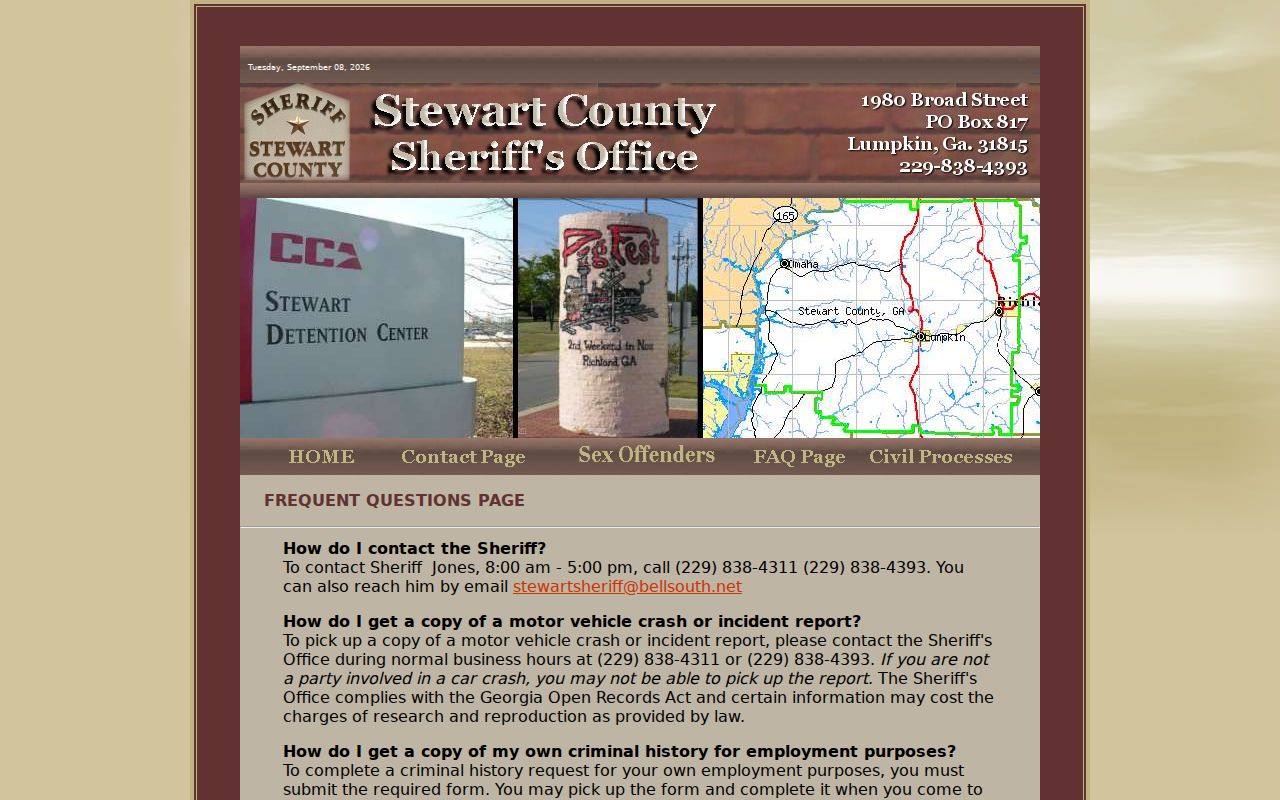
The page supports using the sheriff for confirmation and routing. It offers no person-level warrant roster for Stewart County.
Inside an Active Warrant Record
A nonrestricted Stewart County warrant record can carry the subject's identifying details, alleged offense, issuing judge or court, issue date, warrant number, status, service information, and bond terms. The county exposes no public results screen. Each item must be requested from the office that holds it and verified. Some fields may be withheld or absent.
| Warrant Number | An agency or court identifier; no published Stewart format was documented. |
|---|---|
| Charge / Offense | The allegation or missed obligation tied to the process, not proof of guilt. |
| Issuing Court | The office that controls the file, recall, and disposition. |
| Bond Amount | Only if set and releasable; terms can depend on the charge. |
| Status | Ask whether active, served, recalled, quashed, or closed. |
Issue, service, and recall dates help reconcile conflicting records.
Stewart County Warrant Resolution Courts
The Superior Court Clerk at 229-838-6220 holds the filed Superior Court records. Magistrate Court, listed at 229-838-0505, handles warrant-related criminal functions. Probate Court handles some county traffic matters. Lumpkin and Richland municipal courts take city traffic and ordinance cases. Neither city posts an online warrant roster. Ask the sheriff to name the issuing court. Then ask that court about the appearance, bond, and motion procedures that apply. A recall withdraws the warrant by court action. A motion to quash asks the judge to cancel it. Calling for information or filing an Open Records request does not stop enforcement by itself.
Warrant Roundups and Most-Wanted Lists
Stewart County runs no warrant roundup, amnesty day, safe-surrender program, or recurring clearance event. No official most-wanted roster appears either. Never trust an unofficial deadline. Do not pay a third party that promises to clear a warrant. Verify any future program carefully. Check its dates, eligible warrant types, exclusions, issuing agency, and whether participation actually recalls the process.
Key point: The official Sheriff's Office site is the proper place to check for a future official notice. It does not currently publish a Stewart most-wanted list.
No names, photographs, or addresses should be copied from a roster. Official entries can change when warrants are served or recalled.
Active and Bench Status Differ
An arrest warrant rests on a judge's probable-cause finding. A bench warrant or failure-to-appear warrant can follow a missed date, a violated directive, or an unresolved citation. Both kinds can stay active in Stewart County. Each sits on a different file with its own resolution path. Probation and parole matters run separately too. A Superior Court inquiry will not settle a Lumpkin municipal case. A county records request cannot make a city court produce records it never keeps. For city routing, call Lumpkin city hall at 229-838-4333 or Richland city hall at 229-887-3323. Richland Police lists 229-887-3530 for non-emergency calls.
When Your Name Is on the Warrant List
Get official confirmation first. Then skip the surprise visit to the Stewart County jail. A lawyer can call the issuing court and the sheriff, learn the charge, and ask about voluntary surrender, first appearance, bond, or a motion to recall or quash. Under the sheriff FAQ, bond may be set at once or within 72 hours, depending on the charge. No result is guaranteed for every case.
Important: Consult an attorney before surrendering. Active process can lead to arrest during a traffic stop or other law-enforcement contact.
Get it in writing. Ask for written proof of any recall, quash, release, or disposition, and make sure the Stewart County sheriff and other affected agencies received it. A bond handles custody under a court order. It does not close the underlying case.
Restricted Stewart Warrant Records
Not every Stewart County warrant record is open to the public. The Georgia Open Records Act allows exemptions. Court rules can shield sealed files, and juvenile records usually need a juvenile court order. Investigators may also withhold unserved process when release would compromise an investigation. The county request form can seek an existing nonexempt record, but it cannot force the county to build an active-warrant list. Name a person, a process number, an office, and a date range. If the custodian denies or redacts, ask for the legal basis in writing. A released copy is still a dated snapshot, so check for later service or recall before relying on it. Keep the request, the response, and any court order in one file. When a document leaves a status blank, ask the issuing court instead of guessing. If another office holds the record, send that office a focused request rather than stretching the first one into a countywide compilation of outstanding warrants.